How to build consistency without burning out
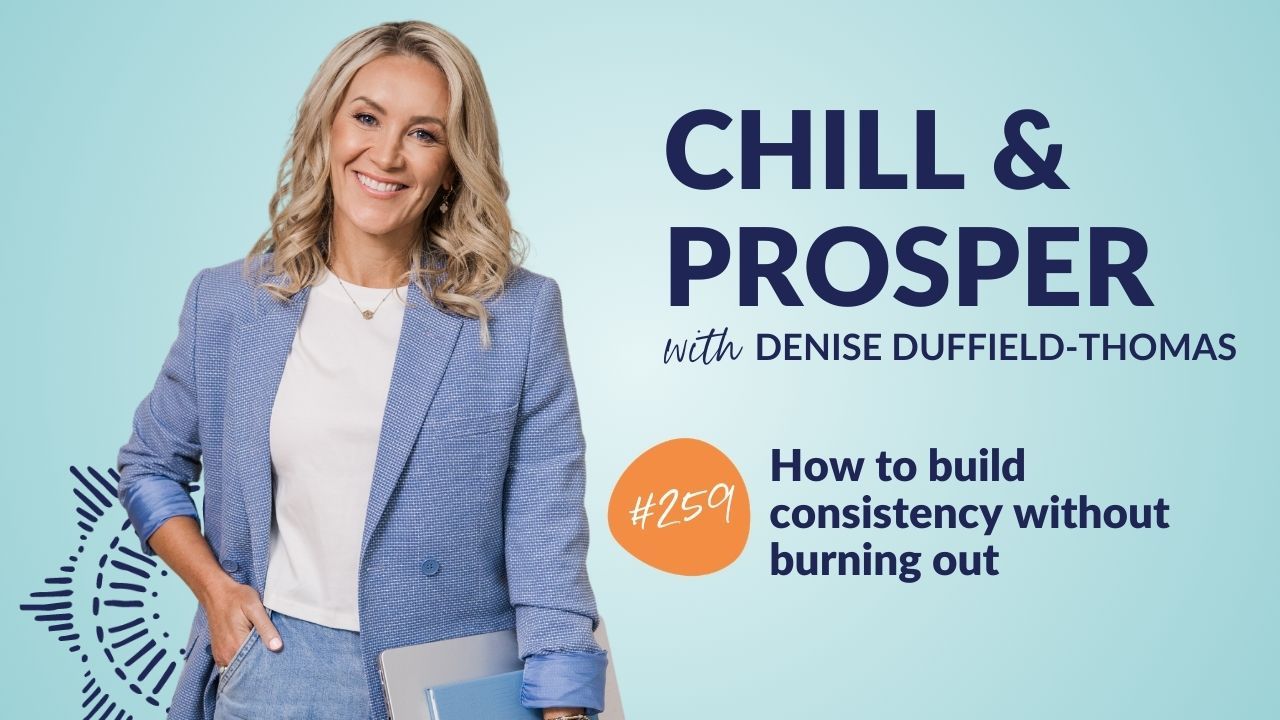

EPISODE 259
How to Build Consistency Without Burning Out
Hey gorgeous,
Let me say this upfront:
Your business can be consistent even if you aren’t.
That’s not a contradiction - it’s actually the whole point of this week’s Chill & Prosper episode.
Today I’m breaking down exactly how I’ve created consistency in my business without working all the time, being “on” every day, or turning my life into content.
We talk about:
✨ why consistency doesn’t mean constant effort
✨ the daily / weekly / monthly / quarterly rhythm I’ve used for years
✨ how batching creates freedom, not rigidity
✨ why systems protect your creativity instead of killing it
✨ and how consistency quietly builds trust, sales, and momentum
This episode is especially for you if:
– consistency feels exhausting
– you feel behind before you even start
– or you want more spaciousness and a thriving business
You don’t need to hustle harder.
You need a framework that supports your life.
xx Denise
P.S. At the heart of being consistent, is having positive habits around money and my mindset. Keeping my mindset focused, clean and abundant is crucial to building the business and life I want - because without the right habits it’s so easy to slip back into scarcity and fear - especially at the moment.
To help you upgrade and strengthen your money habits, I’ve created a free 30-Day Money Mindset Journal with simple daily tasks, prompts and affirmations.
Click here to download your copy and start today
Transcript
Prefer to read? Here is the transcript for this episode:
Okay, so I thought you might have heard me mention this before, that my business is consistent even though I am not. And so I wanted to talk a little bit more about this, about how this practically works in my business to create consistency, but also what it has done for me as a as a human, as a creative person, to not work all the time.
And I almost kind of look back a couple of years ago and I go, wow, I really just worked a lot. And I it didn't feel hard at the time. It felt really fun and energizing and creative, but it also wasn't very balanced. And necessarily kind of efficient. Right. So, I do feel like now I can mentally take more time off and a bit more mentally separated from my business, but I still have that consistency.
And I actually, I noticed this on the weekend that I had like, nice hair and, I just felt like, oh, I should take a video of this. And it was kind of almost like that mentality I had a couple of years ago where I always felt like, oh, everything's content. I have to create so much content all the time.
And so it was either Marc or myself being like, we should film this, we should film this. And I just went, oh, no, I don't have to like, I can just enjoy this for myself, and I can have that mental bandwidth without always feeling like my life is up for consumption, right? And, do you remember a couple of years ago when, like Gary Vee, who you know, is such a prolific creator, he said something like, oh yeah, I, I create monthly heaps of pieces of content per day.
And I remember just thinking I felt so exhausted by it, but I also felt really behind. And I felt, I don't know, just like, oh my God, if I haven't done this 20 times today, I'm a loser. And let me just say, there will be times in your business where you are in empire building mode and you are thinking about it 24 seven but there will also be times in your life where you don't want to, and you actually want to spend your energy on other things.
So, you might have seen on my social media or, or even on this podcast where I talk about some of the creative projects that I work on. So I love cross-stitch, and cross-stitch for me takes forever. I feel like I'm really slow at it. And I do diamond art sometimes, but really, where my creative energies lie these days is going to dancing, particularly ballet and also making dance costumes.
And sometimes, you know, people be like, how do you have the time, like to do all these projects? And the reason why I have the time is because I've created, consistency in my business, but I've carved out time, to do those things without it being a 24 over seven job. And that is so tricky. Is entrepreneurs, right
Because we always think I could do more, I could create more. There's always more stuff to do. And the way that I've, set up these systems in my business give me that space to have that creativity. And, and they, they really, really help. So I just wanted to. Yeah, I wanted to give some, insight into how this practically works in my business because my marketing, plan is very, very simple.
And it's so simple that I actually don't need to think about it that often. And that is, daily presence on social media, some, some, some form of daily presence. And I'll, I'll nodding to each one a little bit more, some sort of weekly offering. So that could be, a podcast, an article or whatever, some sort of monthly, like promo of an opt in or some sort of like marketing campaign, quarterly launch.
And that's how I've run my business for years. It is not more complicated than that, and I really don't have to think about any of those things now. Sometimes people rebel a little bit against a system and they go, no, I don't want to do that. I don't have to show up every day. And I'm like, you don't have to.
I'm just telling you what has really worked for me and also what has made me millions of dollars. And is not more complicated than this. Okay. Don't feel like I've no any super fun, smart strategies, I really don't. I'm just like, yeah, I'm just doing it. Anyway, so let's talk about that system daily, weekly, monthly, quarterly.
Let me just sorry, I just got to do my little timer thing. That's see, that's one of my systems is timing. Timing my, my podcast. Anyway, so daily presence on social media, what does that mean now that might feel so exhausting to you. You're like, oh my God, 365 posts. I don't think I could do it, and that's fine, especially when there are so many different channels and there's so many different ways you can show up.
The idea of it can sound really, really exhausting. So the way that I've being able to do this is, through intense batching periods and batching is just when you do a similar thing in a short period of time. So I can I know what my social media kind of schedule is going to be. Right? So Mondays we do a goal setting post and Thursdays is when the podcast comes out.
And in between that, I've kind of set up my own little rules about what could go. And I can't remember the top of the head, my head, because they're sometimes different every year, but they'll always be like, and know like and trust factor thing. So a bit more casual. Denise and I try and mix those up with, like more curated fancy pictures of me.
So then throughout the week, people get a little bit of an overall picture, right? They'll have some tips posts. So have some strategy post. They'll have some money mindset post, they'll have some silly posts to kind of over the week, give a a sense of my personality, but also to show up as someone who is, consistent and helpful and useful and funny and silly and all those kind of things.
Now, if I had to sit and do those every day, there would be days where I just have nothing to give. I have no energy, I've no like nothing. And so when I sit and create those, I'm creating a gift of myself, of consistency. Now again, you might think, but my audience isn't okay, that's totally fine. I'm just saying, I have created so much goodwill and, like customers by being a consistent presence in people's lives.
That's it. And I try not to overthink it too much. So if I know that every Monday I'm going to do a goal setting post, I can sit and do those. And I'm, you know, I can sit and do them in a day for all of the Mondays. But the way I do it, to keep myself amused a little bit is I won't sit and do the next, you know, six Mondays in a row.
I'll go and do like the first Monday of the month and feeling all of those, and then the second or the third Monday and I fill it in like a little bit of a puzzle. So even if I give up halfway, I'm still ahead of myself. The other key for this is that I, I make things on Canva, but I schedule them straight away, like I'm not making a million bits of content and then doing it all on Canva.
I'll make a couple at a time, export them and and put them up, straight into my schedule. Okay, so I've kind of gone through this process a little bit before, but the mindset of it is it's okay for me to do the work when it's convenient for me, because it will show up when it's needed for for the audience.
And people get used to those things of you showing up. So people get used to that weekly thread so they can put their stuff to their, goals on there. And that's really easy for me to sit and create that I can't necessarily create all the podcast ones ahead of time because I, I don't always know what they're going to be, but this year I did do much more intense batching of my podcast.
So normally what I'll do is four times a year, I'll go into the studio and I'll try and do at least ten episodes in a day. And I just sit there and I just talk, and it's just like, it can get tiring for sure. But I love the fact that I even though I'm like, oh, it's such a pain to do that.
I'm always so grateful for myself that I've done that. And this year I did most of mine, like much earlier in the year. So then I was like, oh, I don't have to think about it. But actually what I did was even better. I planned everything out for the year. So even if I didn't record that podcast, I knew what the flavor of that month was going to be for social media.
So then it's again, it's like doing a puzzle. And when I actually do a puzzle, I always go for like, I'll find the corner pieces and then the flat pieces, but then I'll collect everything in different colors and I'll work on that for a bit. And if I'm bored or working on another little bit, and having this mentality for me makes it easier.
If I'm procrastinating, I can go and I call it my decoy to do list. I can just go procrastinate on something else. Okay, now do my Friday post or my Friday post will be about me and dogs and then easy to get into that kind of mentality. So that is that's how you create a lot of content. And I would suggest to you it's always finding the easy things for you.
If you like video, do video, if you like images, do that. If you don't want to show your face, you don't have to. And it is just about like, what can you set and batch create because of that, consistency will show up in so many great ways in your business. So that's that's my daily. Now you might think, oh God, but what do I what do I post?
And again, that's just a little bit of work of going what's in scope, what's out of scope. And so for me, I go, okay, money mindset, money blocks, pricing, business tips ease. And I try not to stray from those content pillars because then it's easy for me to go, okay, well, if I did a monthly pricing post, I only need to come up with 12 different ways to talk about pricing.
And there are infinite ways to come, you know, to talk about anything. But, you know, you can put it into ChatGPT and say, okay, I need 12 different posts about X or Y or Z or whatever. Now let me give you another, like inside of that house, consistency can just be so good for sales. All right. So one for SEO.
If you've created a lot of content around different things, especially if you've covered like every angle of your topic, you will show up right? So if you've got YouTube videos, even if they're old, having that consistency there, someone will find you. And this is exactly what happened recently with, something that I bought. So I was googling, how did you stage makeup for ballerinas?
So I found this video. It was a really great tutorial. And so then I followed her on Instagram and on Instagram. She was sharing all these tips about, exercises for ballet. So it wasn't even about the makeup, but it was still relevant to me. So I started watching all of the videos on her feed and they were all relevant because they were all about strength and for ballerinas and, you know, all these different training tips.
And I really liked how they were very short but very she wasn't trying to cover everything in every video. Every one was a specific theme. And I don't know if she fell more all at the same time right there. And I was bingeing them, so I didn't need them to come out on her schedule. I wanted to watch them on my schedule and then, you know, forgot about it.
And then, of course, because I was watching her stuff, it's I was showing up in my algorithm and I think between googling her and finding her video and buying from her was a day maybe never heard of this woman before in my life. And I bought from her because I could see she was consistent. She was showing up and she'd covered all of these different angles.
So that's what that consistency can give you is building that credibility, building that, body of work and all those different little angles. But also it was very simple then to, to buy from her. Okay. So I, I think that consistency too can set up that trust factor of, you know, this is someone who's been around for a long time.
They're a real person. They're useful, you know, and it's very generous sometimes. Is that reciprocity that sets up in someone's mind of like, oh, wow, look at all this stuff that they're giving to me for free. All this valuable stuff. Imagine what's in her, in her, videos. And you don't even need to be that salesy to do that.
It kind of sold itself. And actually, I don't even think there was a call to action to buy her thing. I think I just watched so many things. I went to her link in bio and saw that she had a course and bought it, bought it from her. Right. So that's that power of that consistency. You're not you're showing up and then showing up months later or you know, you've just done one thing.
You've gone I'm not saying there's exceptions set exceptions to the rule, but I'm just saying that's that's the thing. Okay. So that's the daily the daily stuff. And the reason why I again I love that pre scheduling pre batching is that I don't then feel like I'm always behind and I don't have to create stuff all the time.
However you don't have to have all seven days of every week batched often I'll do I'll leave little gaps and those gaps can be good for then those real time things where, you know, yesterday I was at the hairdresser, so I took a little video of that and then I can just post that in real time or I can add it to the next batching day.
And so this space for more topical things in this space for kind of more evergreen things. All right. Let's talk about what that weekly, consistent content looks like. And again some ideas on how to make that really easy.
Okay. Welcome back. So we're talking about creating that consistency in your business, especially around your marketing. And yeah, people can get really freaked out about the daily stuff, but it it really can work in any industry. And my dance teacher has really embraced dispatching, recently as well. And I think having those moments where it's like, I'll create it or I'll make it, can really help you to get focus.
And on one of the last ones, it was just like, oh, okay, cool. We're doing, Halloween. We may as well do Christmas at the same time and be ahead of ourselves, you know? And I love doing that. And actually, on my last photoshoot day, I was like, what times in the year can I do now? And we did, you know, like Halloween and Christmas content that we did use that year, but most of it for the next year, right.
And so yes, you can get a bit more organized. Yeah. It's really fun to do them, do the easy ones. Right. So let's talk about that weekly, kind of consistency in your marketing schedule. So this could be anything. And it can be whatever works for you okay. So it's just something that's a little bit more in-depth than that daily social media stuff.
Sometimes that daily social media is just like sometimes people only sell a few seconds of your face or your work, and it's just enough to like, be a little appetizer. Okay? Once a week, I like to create something that's a little bit more in-depth. So for me, in this phase of my life, it's my podcast. And the podcast is the thing that is the entry point to create all that other stuff.
Meaning I do this video, my team turns it into little social media clips. We get the transcript, we can use the transcripts to do newsletter content. You know, all that sort of stuff. But the podcast is the easy thing for me to create. When I first started my business, so it was articles, you know, and I'd write like a 2000 word article every, every week.
For you, it might be, like a longer video. It could be a resource, it could be a tip that is a little bit more in-depth. And generally this is where we want to take people off social media so into a different platform. So this could be your blog, your website, your podcast, something else. And I think the reason why this is so important is because, social media change their rules all the time.
They change their algorithm rules. Facebook introduced something where you could only put two links a month unless you were paying them. Which really annoys me because I'm like, we built your we built your a network by keeping people on here. Anyway, this is where you can have other forms of list building, other forms, a network.
If social media had to close down, I'm like, well, at least I still got my podcasts that people will listen to and subscribe to. You know, this is sometimes where you, like, get people to opt in or it's just, you know, but you just taking somewhere, someone into a little bit more of a journey. Now, whatever is easy for you is the right thing, FYI.
Okay, there are no rules about any way you have to do your content. It could be, like Seth Godin. Who is? You know, he's such a marketing guru and I think later and all that kind of stuff he did for a while, a daily tip. I don't know if he still does it on his website, and sometimes it would be two sentences, sometimes it'd be a small paragraph.
It wasn't huge, but it was just like, this is my thing. Tim Ferriss, he often does podcasts that are like two hours long, but he does a weekly newsletter that's like things I'm reading, things I'm watching. Like he's a tip kind of thing. Sometimes people do reviews, so it could be a book review or a website review or a case study or something like that.
So it's just a little bit more in-depth. And the reason behind this weekly thing to it, again, it is no like and trust factor, but it is going deeper a little bit into your expertise. So you're showing people this is what I can do for you. This is what I want to be known for. This is how I'm going to help you solve your problems.
That doesn't mean it's salesy, you know? But if you listen to my podcast, you know, I do mention what I do, but I'm not. Like, it's not just about that. And again, we, kind of strategic a little bit about it where we know what our themes are for the year, we know what month, what theme it is for the Money Boot camp every month.
So we try and tie the podcast episode to what that theme is going to be. However, though sometimes I come into the podcast studio and I'm like, I'll just pick something out of like my notes app and I'll just have it literally a note on my phone that if I see something interesting, I go, oh, I'm going to talk about that on the podcast.
I'll just jot it down. So then when I'm in the podcast studio, I can just pull that up and go, okay, cool. And I've really loved doing my podcast This way, where I'm not doing it week by week. I don't need to because I don't have to have completely topical content. But also most of the podcast that you listen to, I would imagine that a lot of them do batch things up.
You know, if you're especially if you've got a very high production value thing, you know, you do your hair and makeup and you would probably just schedule if you had guests come in, you could, you know, schedule your guests, come in, or you just sit there and you just record quite a few. So you're just ahead of yourself.
And, when I started having babies and I didn't, I didn't have the energy to write stuff anymore. What? I, instead of doing a podcast, I would just record videos. So I would record like it 6 to 10 minute video and put that on YouTube. And then so my weekly content was, here's this video on this particular topic.
Right. So that's the, the weekly stuff. And you can yeah, you really can batch that up. You know, as I said, my topics are pricing in money, mindset, whatever. So I can just sit and do all my pricing ones in one go and release them every couple of months, even in the same outfit sometimes. Right. It's like, it's totally fine.
People don't notice that as much as you think. But for me, I love the fact that I've done my bit in the podcast studio and then my team takes care of the rest, and I don't I don't have to think about it any more, until the end of the next time. And that system is taken a little while to kind of get right, but it's still still not perfect, but I just, I love that consistency.
Especially, you know, there will be times where I'm really busy. I wouldn't want to go in the podcast studio. Okay. So that's the that's the daily in the weekly. When I talk about the monthly, this for you could be you create a new opt in. You could create like just something that's a little bit more in-depth, or you promote something that you already have.
You don't always have to create something new. So each month you could go, okay, I've got this really great opt in. You know, I'm going to, tell people about it. I'm going to promote it. I'm going to do some ad spend towards it for us this year, because we knew what those topics were ahead of time. We created an opt in just for that month that related to the topic.
It related to the bootcamp topic and then all of the podcast stuff. So it was just a little bit more like streamlined, but just easier for my brain just to go, okay, all right. What are we talking about in March? Okay. We're talking about this, and so it doesn't have to be something that's super complicated. It's just another way of maybe getting people on your newsletter list, getting people to get excited about something, giving away something for free, doing it, like a mini campaign or something, doing a launch of something.
Whatever it is for you. And I just think, again, it's just easy for my brain to think, okay, once a month we're going to do something. And then you could think of it like once a quarter you do some sort of launch. Now this could be a launch for your business. It could be an affiliate promotion. It could be a special that you do.
So Alice doesn't fall perfectly into each quarter, but we do, like something, usually at the start of the year, we, often have different, like, different countries, have different end of financial year. So sometimes we do a special for a particular country. Sometimes we do a currency special. So we might do a special targeted thing for the UK for example, where we say, hey, you can pay in British pounds, but just for this particular time and it might correspond with like, a public holiday or an in the financial year thing for the UK.
And it is just for that targeted audience. We've done one for Canada, we did one for New Zealand. We did one in euros. We did one for Australian dollars. And again, that quarterly thing is just like, okay, we don't want to leave it too long without doing some sort of sales activity. So again, we did a currency one.
Sometimes we do a payment plan. One we very rarely, very rarely do discounts, but sometimes we might do a bundle. So they could be something like that where once a quarter you go, okay, here's a buy one, get one free. Here's a, you know, a special discount. He's a special bundle. Here is a I don't know, you get something extra free here is a blah, blah, blah.
And I really like that schedule of just, again, don't have to think about it. You know, it's just like, it's just that's what we're going to do and your business, your rules. Right. But that daily, weekly, monthly, quarterly thing has worked so well for my brain. And it just works really well at the start of the year to to kind of plan those out.
But that's how I've created that consistency in my business. But without burning myself out, without feeling like I have to be working all the time. And it's so good to put parameters around when you show up. Okay. And so now I can just I can kind of always be a little bit strict with my team about that of going, nope, this is, this is where I'm going to do my stuff and I really want to refine it.
So this year I want to make sure that I have most of that stuff done for next year. By November, because, yeah, last year it went too far into December and I was like, no, no, no. So when you once you have that framework, it's easy to fill in the pieces. And just do what do you what feels good for you.
It really does. So yeah. Anyway, hopefully that's giving you some insight into, how I run my business and yeah, how it just makes it really easier and consistent. Okay, don't go away. I've got one final thought for you after this last break. See you in a second.
Okay. Welcome back. So, you know, I talk so much about batching on this podcast, and sometimes people resist it. For different reasons. It feels complicated. It feels hard. And you, you really can start really simple and easy. It doesn't have to be all or nothing. And, you know, remember, we've been talking, you know, each month we're going to do a particular topic.
And for this one to is, having those like those regular money mindset things every single day. So don't forget to download that, denisedt.com/mar, the 30 day money mindset journal. Because building those little consistent habits every day can really, really help. You know, it can really help you to to go to that next level. And some of them are important to do every day because you want to feel good every day.
But some of those, from a business point of view, they don't have to be done every day. Your business can be consistent without you having to stress about it and and without being perfect, because we're not here just to work in our businesses all the time, you know, and they can feed each other. Having spaciousness and creativity can really help me feed, you know, business ideas for when I need to do that in, in bursts.
So it's your life, your rules. It really is. But, I really want to help. I really want to hear if my batching stuff has inspired you. So please reach out. You can always DM me @denisedt. And yeah, I just want to hear what little tips and tools have you done to make it easy for yourself.
And this last tip that I want to say too, is sometimes having things set up is been really helpful for me. So coming into the podcast studio, you know, I have my big suitcase, I'll have the lights ready to go. I have, you know, plugs and stuff and I don't know, sometimes just having that set up, maybe it's a tripod that's set up in your office so you can just go, okay, I'm ready because there's nothing worse than going to start something and you go, oh, I have no battery or now I've got to find the thing.
And that I think that can really help as well. So set yourself up for success. Whether it's, you know, daily, weekly, monthly, quarterly, whatever it is. And I hope I've inspired you for it. One day I'll do, like, a batching bootcamp where we all just go away together and thought we found, okay, have a great week and I'll see you on next week's episode of Chill & Prosper.
FREE 3-PART VIDEO SERIES
Rewrite Your Money Story
Discover where your money patterns came from, how they’re affecting your income today, and how to create a calmer, more abundant future.
If money feels harder than it should…
If you earn more but still feel anxious…
If you undercharge, overgive, or constantly second-guess yourself…
It’s not because you’re bad with money.
You’re likely running an old story you never consciously chose.
Start rewriting your money story today...