Women and Money: Why We Undercharge, Over-Give, and How to Change It
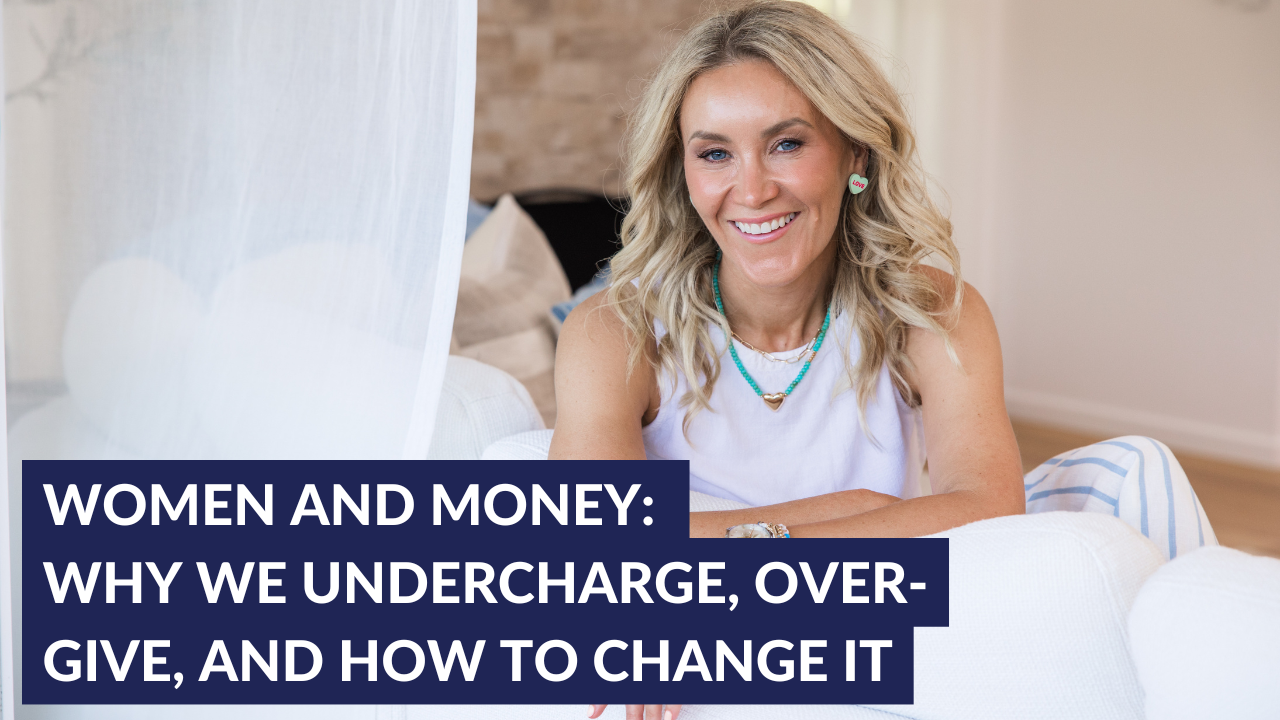

Let me tell you about the first time I walked into a financial advisor's office as a business owner.
I was sweating. I mean, properly, embarrassingly sweating. I felt like I was about to get into trouble, even though I hadn't done anything wrong, even though I was the one who'd made the appointment, even though the whole point of the meeting was to help me.
I defaulted to "let Mark explain it" about three different things. Mark, who is my husband, was there because I'd asked him to come. And yet, in that room, talking about money in a formal context, some very old wiring kicked in and suddenly I wanted the man in the room to be the one answering questions about my own finances.
I caught myself doing it and it genuinely shocked me.
Because intellectually I knew that was wrong. I run a business. I've read more books about money than most people will read in a lifetime. I teach money mindset. And yet there I was, with every instinct telling me to make myself smaller in a room full of money conversations.
That's what generational money stuff does to you. It's not rational. It's wiring. And for a lot of us, the wiring around money and gender runs very, very deep.
What's really going on
Entrepreneurs have a complicated relationship with money. Not because we're bad with it. Studies consistently show that women investors outperform men. Women-owned businesses have grown exponentially over the last two decades. There is no shortage of evidence that we are brilliant with money.
But many of us have been taught, generation after generation, that money isn't really ours to claim.
We were taught to defer. To be modest. To not be too ambitious or too visible or too focused on financial gain. To care more about helping people than about what we charge them. To put everyone else's needs first and hope there's enough left over.
We inherited money stories from our mothers, who inherited them from theirs, who were literally navigating a world where women couldn't open bank accounts without a husband's signature. That world ended within the lifetime of many of our parents, not ours.
Those stories don't just evaporate because the laws changed. They get passed on. In the way money was talked about at the dinner table. In the way our mothers hid spending from our fathers. In the way ambition in girls was praised a little less enthusiastically than ambition in boys.
You absorbed all of it. So did I.
The patterns I see most often
Undercharging and over-delivering. This is so common it almost feels like the default setting. Pricing based on what you think people can afford rather than what your work is actually worth. Adding extra sessions, extra bonuses, extra hand-holding, not from genuine generosity but from a quiet belief that you have to earn the right to your own rates.
Money guilt. The feeling that having more than you "need" is somehow selfish or wrong. That wanting to build real wealth, not just survival money, but generational wealth, genuine financial freedom, is greedy. That you should want to help people more than you want to be paid.
Financial avoidance. Not looking at bank accounts, not opening letters, not tracking income because knowing feels too scary. This one often comes with shame about past financial decisions, debt, a business that didn't work, an investment that went badly.
Handing control to partners. Like me in that financial advisor's office, many people find themselves deferring financial decisions to a partner even when they earn the majority of the household income. Or not wanting to understand their own business finances because that's "not their thing." Or outsourcing their financial wellbeing to someone else and calling it delegation.
Visibility fear. Not marketing, not raising prices, not putting work out into the world, because some part of you believes that becoming financially successful will make you less likeable, less safe, less connected to the people you care about.
I talk about this more in my post on overcoming money fear.
The thing we don't talk about enough: wealthy people change the world
I believe this with everything I have.
When people have more financial resources and strong values, they tend to do more good in the world. They fund causes they care about. They create jobs. They raise children who think differently about money. They have the time and capacity to give generously rather than from a place of scarcity.
The people who are hoarding wealth and making decisions that harm others are, largely, not reading blogs about money mindset. They're not asking themselves whether their financial ambitions are ethical. They're not worried about becoming "one of those people."
You are.
Which is exactly why the world needs you to have more money, not less.
Your values aren't something you'll have to sacrifice on the altar of financial success. They're the reason your financial success matters.
Where to start if this is resonating
Find your origin story. What's your earliest money memory? What was money like in your family? Was it scarce, was it fought over, was it never talked about? Was wealth associated with people who were bad, or people who were out of reach? The stories we tell about money come from somewhere real, and tracing them back is the first step to updating them.
Look at your money language. What do you actually say about money, out loud and in your own head? "I'm terrible with money." "We can never afford anything." "I don't know anything about investing." These casual phrases become self-fulfilling prophecies. Start catching them and replacing them deliberately.
Take one small act of financial ownership. Open your banking app right now if you've been avoiding it. Book a call with an accountant. Look at your business revenue for the last month. Understand one thing you've been handing to someone else. Ownership builds confidence.
Separate your family's story from yours. This is profound and often overlooked work. Your parents' financial story, their fears, their struggles, their ceilings, is not your destiny. You can honor where you came from while consciously choosing to write a different chapter.
Get specific about what you actually want. Not "more money," how much? Not "financial freedom," what does that look like in actual, concrete terms? How much in savings? What monthly income? What does your life look like when money is genuinely not a worry? Dream the specific dream. Vague financial goals don't manifest.
A note on doing this work in community
Money stuff can feel very isolating. You feel like you're the only one with these fears, these patterns, this complicated relationship with finances. And because money is still a taboo topic in most social circles, there's nowhere to bring it.
That's a big part of what Money Bootcamp is. Not just a course, a community of thousands of people working through the same blocks, sharing their stories, celebrating their wins, holding each other accountable. People who come in thinking their money stuff is uniquely shameful and realize within days that they're not alone at all.
The work is faster and deeper when you're not doing it in isolation.
When you're ready to go beyond solo reading and do the real clearing work, Bootcamp's here.
And in the meantime, know this.
You were not born to be small with money. Whatever messages you absorbed along the way, they were handed to you by people who had received them from people before them, all the way back. You get to put them down. You get to decide that this is where the pattern stops.
That's not naive. That's actually the most practical financial decision you can make.
It's your time, and you're ready for the next step.
xx Denise
FREE 3-PART VIDEO SERIES
Rewrite Your Money Story
Discover where your money patterns came from, how they’re affecting your income today, and how to create a calmer, more abundant future.
If money feels harder than it should…
If you earn more but still feel anxious…
If you undercharge, overgive, or constantly second-guess yourself…
It’s not because you’re bad with money.
You’re likely running an old story you never consciously chose.
Start rewriting your money story today...