Money Blocks for Dance Studio Owners: Why You Feel Bad About Charging (And How to Change That)
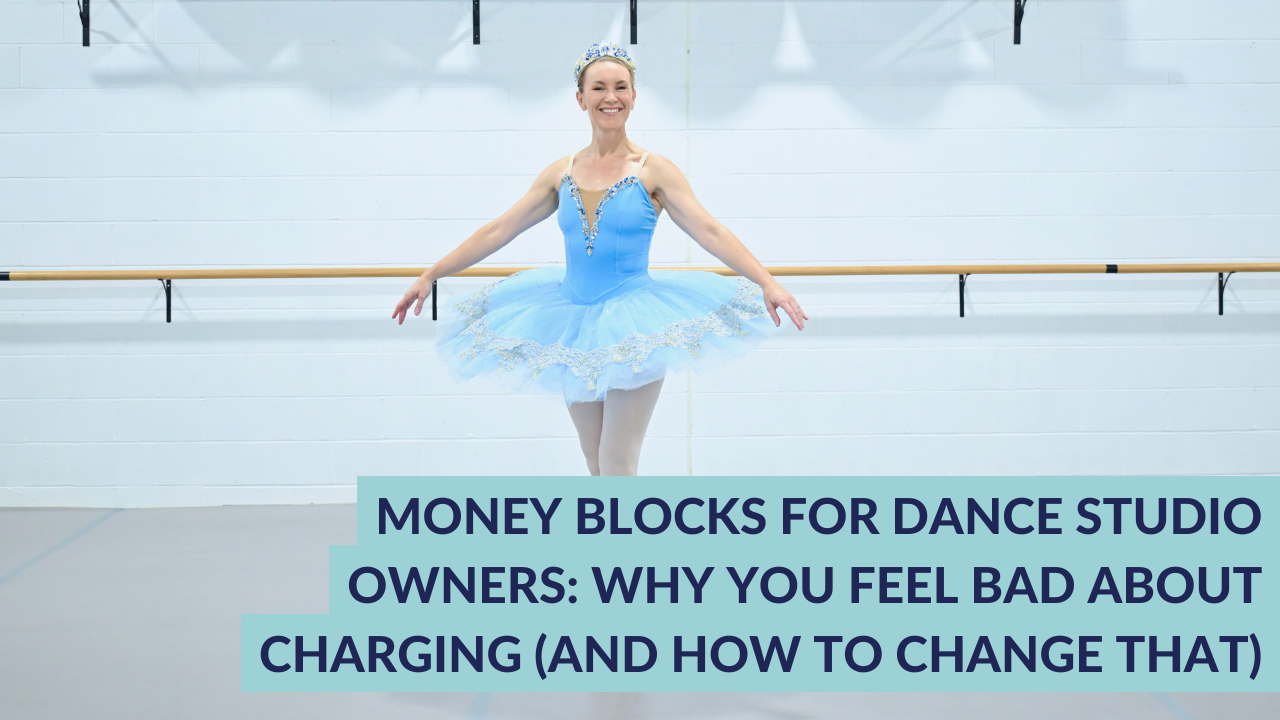

Here's the thing about dance teachers: you didn't get into this for the money.
You got into it because dance changed your life. Because you stood in a studio as a kid and felt something shift. Because the hours you spent rehearsing, competing, and performing weren't hours at all — they were just where you lived.
And now you've built a studio, you're teaching classes, you're shaping kids' lives in ways their parents will tell you about years from now. You're doing everything right.
Except you're not charging enough. You're not charging for everything. You're probably not charging at all for some of the work you do. And every time you think about putting your prices up, something stops you — a vague guilt, a worry about what the dance community will think, a voice in your head that says this is supposed to be about the love of dance, not the money.
That voice is a money block. And it's one of the most specific, most deeply ingrained ones I've ever seen.
I come from a performing background. I danced from age 8 to 16, two nights a week at Simone's School of Performing Arts on the Central Coast. I spent my school holidays working as a performer for Bugs Bunny and Looney Tunes shows in Westfield shopping centers all around Australia. I later performed as Millie the Echidna at the Sydney 2000 Olympic games. I started a dance group at school instead of going to PE.
I know this world. I know what it gives you, and I know exactly what it takes from you if you don't watch it. Let me walk you through the three biggest money blocks I see in dance studio owners — and then I want to tell you about Mickey Mouse, because it changed everything for me.
Money Block #1: "The Show Must Go On"
This is the hustle block, and in the dance and performing arts world it has a very particular flavour.
When you are a performer, it gets drilled into you from the beginning: no matter what happens, the show must go on. The floor is slippery — you modify the choreography. Your costume malfunctions — you keep dancing. Your hat falls off — you leave it. The stage collapses — you figure it out. You show up. You deliver. That's what professionals do.
I have so many stories from doing those Bugs Bunny shows. We'd arrive and the venue would say, "Oh, you're doing your tap routine on grass." And we'd just go, okay. We'd arrive and the dressing room was a tent. We'd arrive and the stage had been set up wrong. And we just made it work, because the show must go on.
That ethos is beautiful. It builds resilience, discipline, professionalism. As a dancer and performer, it served me brilliantly.
As a business owner, it quietly nearly destroyed me.
In a studio, "the show must go on" looks like this:
- Burning out because you believe dedicated teachers always push through
- "Chipping in" as a team player — covering classes, absorbing extra hours, never tracking what you're owed
- Saying yes to things you've already outgrown, because you can't bear to let anyone down
- Doing everything yourself because you're faster and it feels like a betrayal to hand it off
- Never taking sick days, never rescheduling, never admitting when you're running on empty
I had a podcast interview scheduled once when I was genuinely sick. And my first instinct was to just push through. It took a real moment of reckoning to simply email and say: I'm sick, can we reschedule? She said of course, no problem. And I remember thinking: why did I not think I was allowed to do that?
That's the show must go on mentality. And it lives in studio owners who came up through performing arts culture in a way that I rarely see in other industries.
It also shows up in how you say no after you've already said yes. I was eight and a half months pregnant once when I agreed to a morning TV interview that would happen six weeks after my baby was born. I said yes because it was TV — it felt like the kind of thing you couldn't say no to. I spent the entire last month of pregnancy and the first weeks with my newborn thinking up excuses. Eventually I sent an email, apologised, said I'd overcommitted. And I thought: why are we doing this to ourselves?
In your studio: is it actually a disaster if you reschedule a class because you're sick? Is it really the end of the world if you say no to the committee role you've outgrown?
Most of the time, it isn't. The show does not have to go on. You are allowed to rest.
Money Block #2: "I Can Do What I Love or Make Money — But Not Both"
This is the purity block, and for dance teachers it runs very, very deep.
Think about it. You probably spent years dancing for free — or close to it. You danced because you loved it. You stayed late at rehearsal not because you were paid but because you couldn't imagine being anywhere else. The performing arts world has a long tradition of treating money as somehow separate from, or even contrary to, the art. Real dancers sacrifice. You suffer for your craft. The passion is the point.
And now you're running a business. And charging for it feels wrong.
Maybe you feel guilty asking dance parents to pay for something that feels so personal and precious to you. Maybe you automatically discount for families you assume can't afford the full rate — before anyone has even asked. Maybe you feel afraid or embarrassed when it comes to the actual money conversation. Maybe you worry about what other dance teachers in your area will think if you charge more than the going rate.
This block shows up as:
- Being afraid or guilty to ask for money, even for work you've clearly already done
- Discounting automatically and reflexively, before anyone pushes back on price
- Assuming families won't pay a premium, so you never offer one
- Worrying what the dance community will think if you raise your fees
- A persistent background hum of guilt when the studio does well financially
Here's what I want to say directly: you probably spent countless hours dancing for free because you loved it. That love is real. It hasn't gone anywhere. But running a business is different from being a student or a performer. You are providing something genuinely valuable — technique, discipline, confidence, community, joy, performance opportunities — and you deserve to be paid for it.
Do what you love and the money will follow — but only if you actually let it.
And here's the reframe that I find shifts things for dance studio owners specifically: being generous doesn't mean suffering yourself. Charging well is exactly what allows you to be generous in the ways that matter. Offering the occasional scholarship. Buying better equipment. Paying your teachers properly. Keeping your studio open and sustainable for the next generation of students who need exactly what you offer.
You cannot pour from an empty vessel. A studio that is financially thriving can do so much more for its community than one that's scraping by because its owner felt too guilty to send the invoice.
"It's okay for me to make money and have fun and help kids."
All three. At once. Not one or the other.
Money Block #3: "I Have to Work Really Hard to Make Money"
This one keeps studio owners trapped in a model that cannot scale.
The belief is simple: money only comes from hard work. The more hours you're on your feet, the more classes you're teaching, the more you're physically present — the more legitimate your income. And if you start making money in ways that feel easy, or without you being in the room, something must be wrong.
For studio owners, this shows up as:
- Overdelivering and undercharging — packing your schedule without ever adjusting rates to match your actual value
- Doing every task yourself, even the administrative, operational, and logistical ones that someone else could handle
- Sabotaging your own income right when things are going well — adding free classes, discounting packages, suddenly finding reasons to give more for less
- Being afraid to offer premium services — private coaching, intensive holiday programs, performance squads — because it feels presumptuous or greedy
You are allowed to work smarter. You are allowed to create programs and offerings that generate income without you being physically present for every minute. You are allowed to charge a premium for your expertise. Running a well-structured, profitable studio is not a betrayal of your love for dance. It is how you build something that lasts beyond your own physical capacity to show up.
You Are Mickey Mouse
I want to tell you about something that completely changed how I run my business. And I think it's going to land particularly hard for anyone who comes from a performing background.
I took my kids to Disney on Ice. And I noticed something. My kids didn't really know who Mickey Mouse was — he's not on cartoons the way he was when I was a kid. But when Mickey came out on the ice, they completely lost it. They were riveted. And I sat there watching, trying to figure out what was happening.
Here's what I noticed. Every time Mickey Mouse appears — at Disneyland, at Disney on Ice, in the parade — there is a production around him. The lights change. A trumpet plays. An announcement is made. Every other performer on the ice stops, turns toward Mickey, and defers. The whole show pauses to acknowledge that Mickey is here. He's at the front of the parade and the back of the parade. He's on every piece of merchandise. The laser show is built around him. He is the undeniable star.
And here's the thing: kids today don't even watch Mickey Mouse cartoons. They don't know him. But when he appears, they feel it — because everything around him is telling them it's a massive deal.
I went home from that show and looked at my own business and thought: am I the Mickey Mouse here? Or am I the background dancer?
At the time, I was absolutely the background dancer. I was moving tables at my own events. I was checking people in at the door. I was answering every question in my community — including the ones tagged on Christmas Day, including the ones on weekends. I was doing my own hair and makeup and then running on stage. People were taking my energy completely for granted, because there was nothing in the structure of my business telling them they shouldn't.
I was not the Mickey Mouse of my own business. I was the always-available, always-exhausted stagehand who nobody had to make a big deal about.
So I started making changes. Deliberately.
At my events, I started having someone give me a proper, warm introduction that built energy before I walked out. It felt strange at first, like I was being self-important. But the audience sat up straighter. They arrived ready to receive, instead of already accustomed to me bustling around fixing things before the show. At my book tour in New York, I had Gala Darling come as my warmup act and introduce me. The whole energy shifted.
I started hiring people to handle logistics so I could be fully present for the part only I could do. Think about what happens at Disney — the staff aren't just managing crowds. They're actively building anticipation. "Who are we seeing today? Mickey Mouse! I can't hear you — who?!" That's not accidental. That's deliberate staging.
I hired a community manager for my Money Bootcamp, and from the very beginning I was specific about the brief: this role is not for you to become the star of the group. It's for you to showcase the Money Bootcamp work and direct people back to the material. So when someone asks a question, the answer isn't "here's what I think" — it's "remember when Denise talks about this in Module 3?" or "this is exactly what the energy level exercise is about." It keeps my energy and ideas at the centre of the community, even when I'm not physically in the room.
We even closed the community for two weeks over Christmas — because I'm allowed to take time off, and modelling that is part of the work.
Now. For you, as a dance studio owner, this applies in ways that are very tangible.
Are you the Mickey Mouse of your studio? Or are you the background dancer?
Does your community know — really know — that your time and expertise and energy are special? Or have you made yourself so available, so always-on, so reflexively present for every question and problem, that there is no reverence left?
Being the Mickey Mouse of your studio doesn't mean you think you're better than your team or your students. It means you understand that there is something only you bring — your specific experience, your irreplaceable presence — and that you have a responsibility to protect and honour that, not give it away to everyone who messages you at 10pm.
In practice, this might look like:
- Getting someone to give you a proper introduction at your next recital, instead of rushing from backstage logistics straight to the stage
- Having a studio manager or admin person handle initial enquiries, so your time feels like something to look forward to rather than always available
- Building a culture in your studio where your knowledge and expertise carry appropriate weight — you direct the programming and creative decisions, your team handles the implementation
- Closing your messages on weekends and holding that boundary visibly, so parents and students learn when and how to reach you
- Creating premium offerings — private coaching, intensive programs, masterclasses — that feel genuinely elevated alongside your standard classes
The energy around you matters. You are allowed to build a business where your presence is a big deal. Not because you're self-important. Because you've earned it, and because protecting it is how you sustain this work for the long term.
There's only one of you. It's safe to value that.
I wrote a whole piece about the Mickey Mouse business lesson here if you want to dive deeper: Business Lessons from Mickey Mouse.
How to Start Shifting Your Blocks
All three of these patterns come from the same place: absorbed beliefs about what kind of person gets to be successful, what dancing is supposed to be about, and whether you're allowed to receive well for doing something you love.
Here's the process I use:
Step 1 — Take an inventory of your money memories. Not your bank account. Your memories. What did money mean in the family you grew up in? What did the dance teachers who trained you model about charging and worth? What did you absorb from performing arts culture about what real dedication looks like?
Step 2 — Look for the theme. For most dance studio owners it's some version of: dance teachers don't make real money. Or: loving what you do means accepting less. Or: charging well means you've prioritised the wrong thing.
Step 3 — Choose a new belief. Deliberately. Repeatedly. Until the new one is louder than the old one.
My new belief was: "Money loves creativity."
And the affirmation I'd give every dance studio owner right now is this:
"I serve. I deserve."
You built something real. You are changing children's lives in ways that will ripple out for decades. You deserve to be paid properly for that. And the studio you can sustain when you're paid properly will do more good in the world than the one you're grinding out while feeling guilty about the invoice.
Ready to Find Out Which Block Is Yours?
I run a free Money Blocks workshop where I help you identify exactly which pattern is running your business decisions — and what to do to shift it. It's built for people who love what they do and are ready to actually get paid for it.
Join me for free at denisedt.com/blocks — come and find out what's been getting in the way.
And if you're ready to go deeper — live coaching, monthly calls, a community of women doing this money mindset work alongside you — my Money Bootcamp is the next step.
Find out more and join me in Money Bootcamp here. Women in every industry — including plenty of dance studio owners — have been changing their relationship with money inside my bootcamp since 2012.
It's your time, and you're ready for the next step.
FREE 3-PART VIDEO SERIES
Rewrite Your Money Story
Discover where your money patterns came from, how they’re affecting your income today, and how to create a calmer, more abundant future.
If money feels harder than it should…
If you earn more but still feel anxious…
If you undercharge, overgive, or constantly second-guess yourself…
It’s not because you’re bad with money.
You’re likely running an old story you never consciously chose.
Start rewriting your money story today...